
Captain Barry’s Great Adventure: May of 1990
Dec. 30th, 2023
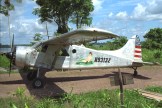
Captain Barry was a Canadian ferry pilot. He flew planes all around the world delivering them here and there. Captain Barry had been hired by Saul Zaentz Productions to ferry the Dehavilland Beaver from St. Cloud, Minnesota to Belem, Brazil. There the plane would be used in the film “At Play in the Fields of the Lord.”
The plane was bought by David Jones who was the aerial coordinator and chief pilot working on the movie. Jones hired Captain Barry as ferry pilot and myself as aircraft mechanic but Saul Zaentz Productions paid our salaries. Jones kept ownership of the plane. It was an odd arrangement.
The DeHavilland Beaver carries 95 gallons of fuel in three separate belly tanks under the cabin floor. This plane, N9313Z, was not equipped with wing-tip fuel tanks. For the long trip from Minnesota to Belem at the mouth of the Amazon River, a 60-gallon auxiliary fuel tank was added in the back of the passenger cabin.
With 155 gallons of fuel, an average fuel consumption of 25 gal/hr, and a cruising speed of 110 knots, the range of N9313Z would be about 600 miles allowing for some fuel in reserve.
Some of the legs on Captain Barry’s long trip from Minnesota to Florida, then island hopping across the Caribbean to Guyana, French Guiana, and then Belem were a little over 500 miles.
Captain Barry arrived with the Beaver at Belem Int’l Airport on about May 28th, 1990. He was tired. I met the plane at the airport and had dinner with Captain Barry back at the Belem Hilton.
I liked Captain Barry right away. He was a smart friendly Canadian. He knew his airplanes.
Barry told me that he had had enough of the “Little Princes” in the Caribbean and South America who wanted bribes and demanded silly paperwork. Captain Barry had to retrace his route once or twice just because his paperwork wasn’t “in order” at some island or another.
When he landed in Cayenne, French Guiana they didn’t accept his paperwork from Guyana and he had to fly back to Georgetown, Guyana over 400 miles.
The next morning Captain Barry flew with David Jones and me in the Beaver to the newly built landing strip at the Madre de Deus airstrip.
Captain Barry played the role of pilot instructor while David, who specialized in helicopters, flew the plane to the airstrip.
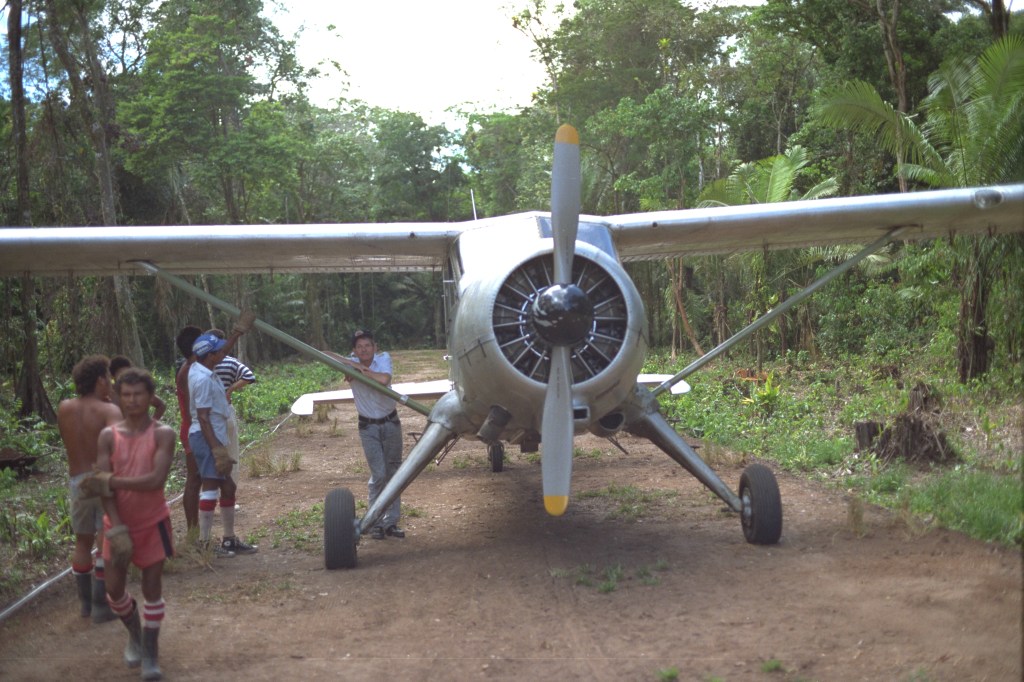
The approach is over the Rio Guama. The airstrip is short, narrow, and one way in and the same way out over the river.
David Jones did the landing hanging on the prop coming in low and slow over the river. We landed with a thump and stopped the plane with about 75 feet to spare.
To turn the plane around, Jones took the plane to the end of the runway where there was a large circle of plywood lying on the jungle floor. Here he locked up the left wheel using the brake, put in full right rudder, and pushed up the throttle. The plane quickly spun around 180 degrees using the left wheel as the anchor point.
We then taxied up the dirt strip to the airport shack. The three of us had just made the first landing on the Madre de Deus airstrip.
That was the scariest landing I’d ever been on. I’d have been even more scared if I knew that the airstrip was built on piers sunk into the mud with thin planking on top covered with dirt. This planking would break every once in awhile during landings.
It was one of my jobs to check the runway for breakage and weak planks before the plane was to come in for a landing at Madre de Deus.
One time I saw a low spot, stepped on it and fell through. Very poisonous bushmaster snakes hung out under the runway in the cool dark water. I got myself out of the knee-deep water in a hurry.
A workman replaced the planking and then on went the dirt to cover it up. This happened several times.
Captain Barry told me that he didn’t like how David Jones hung the plane on the prop on landing. If the R-985 engine so much as hiccuped, into the river we’d go. Barry preferred a gliding-in approach with plenty of airspeed.
I don’t know which technique was better. It was a short strip with no bailout for a mistake.
Takeoffs weren’t any better. In the hot humid air, we’d clear the end of the runway with maybe 20 feet to spare.
Captain Barry returned to Canada via airliner. Jones and I flew into and out of that little Madre de Deus airstrip a dozen times or so. It was always a close thing. Finally, Jones decided to park the plane at the airstrip overnight and use car or boat to get to and from the Madre de Deus filming location. That airstrip was just too dangerous to do all the time.
It was a happy day for me when filming ended at Madre de Deus but then I had to put the N9313Z on floats.
That is another story.
TJM


 Timmy Tae's Thoughts
I can not imagine that fun fun fun on the Amazon
LikeLike